How to Find a Missing Angle of a Triangle: 5 Methods + Real-World Applications
Imagine you’re designing a roof for a new home, coding a 3D terrain in a video game, or solving a geometry problem in school—and you’re stuck with a triangle that’s missing one angle. What do you do? The answer isn’t just about memorizing formulas; it’s about understanding the hidden rules that govern triangles, from the basic 180° rule to advanced trigonometric tricks used by architects, game developers, and even forensic scientists. Whether you’re working with a right triangle, an isosceles shape, or a complex scalene figure, knowing how to find a missing angle of a triangle unlocks solutions in fields far beyond the classroom. But here’s the catch: most guides stop at the basics, leaving you to figure out real-world applications, common pitfalls, and when to use each method on your own. This guide fills those gaps with five foolproof methods, practical examples, and the tools to verify your answers—so you’ll never be left guessing again.
We’ll start with the foundational angle sum property that every triangle follows, then dive into advanced techniques like the Law of Cosines and exterior angle theorem. You’ll discover how triangles shape the world—from the 51.84° angles of the Great Pyramid of Giza to the terrain modeling in Minecraft and the navigation systems guiding airplanes. Along the way, we’ll expose the mistakes that trip up even experienced problem-solvers and provide interactive tools to test your skills. By the end, you’ll not only know how to find a missing angle of a triangle but also when and why to use each method, ensuring your solutions are both accurate and practical.
Quick Answer: To find a missing angle of a triangle, use one of these five methods depending on what you know:
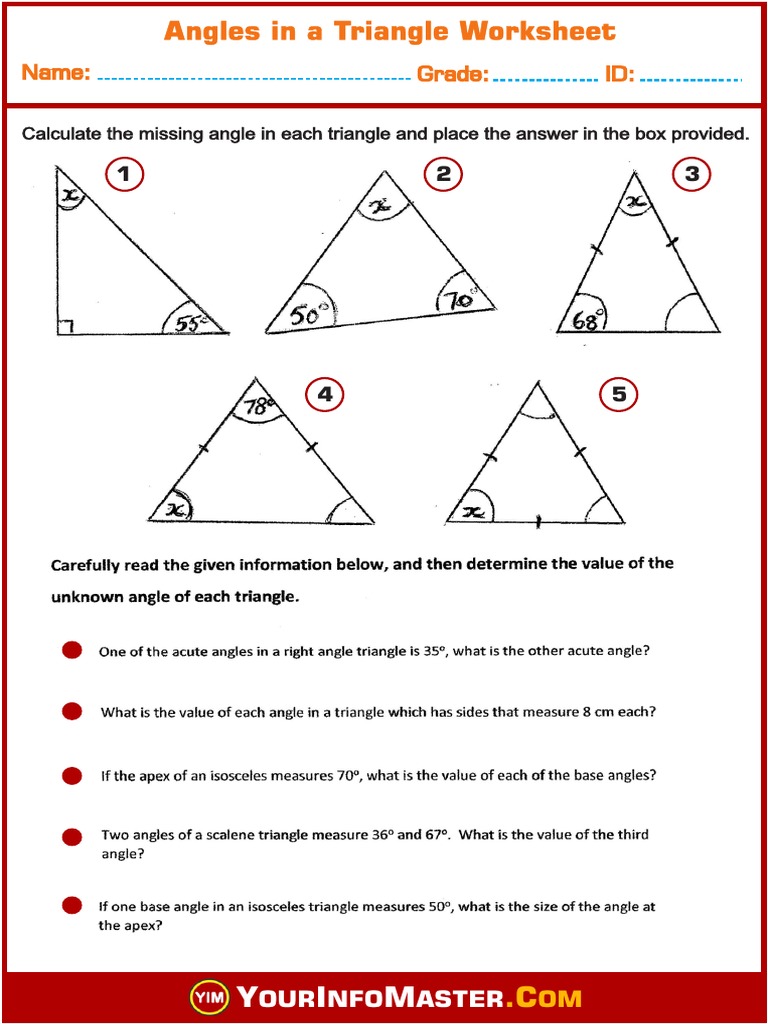
- Angle Sum Property: If two angles are known, subtract their sum from 180° (e.g., 180° – 50° – 70° = 60°).
- Exterior Angle Theorem: An exterior angle equals the sum of the two non-adjacent interior angles.
- Trigonometry: Use the Law of Sines or Cosines if sides are known (e.g., a/sin(A) = b/sin(B)).
- Protractor Measurement: Physically measure two angles, then calculate the third.
- Special Triangles: Right (90°), isosceles (two equal angles), or equilateral (all 60°) triangles have shortcuts.
5 Methods to Find a Missing Angle of a Triangle
Finding a missing angle of a triangle isn’t a one-size-fits-all task—it depends on what information you have. Do you know two angles? One angle and a side? Or just the sides? Each scenario requires a different approach, and choosing the right method can save you time and frustration. Below, we break down five methods, from the simplest angle sum property to advanced trigonometric techniques, along with a decision flowchart to help you pick the best one for your needs.
To decide which method to use, ask yourself these questions:
- Do I know two angles? → Use the angle sum property (Method 1).
- Do I know one angle and an exterior angle? → Use the exterior angle theorem (Method 2).
- Do I know sides and angles (SAS, SSS, ASA)? → Use trigonometry (Method 3).
- Do I have a physical triangle to measure? → Use a protractor (Method 4).
- Is the triangle right, isosceles, or equilateral? → Use special triangle shortcuts (Method 5).
Let’s explore each method in detail, starting with the most fundamental and progressing to the most advanced.
Method 1: The Angle Sum Property (180° Rule)
The angle sum property is the cornerstone of triangle geometry, a rule so fundamental it was documented by the ancient Greek mathematician Euclid around 300 BCE in his work Elements. This method is your go-to when you know two of the three angles in a triangle. The rule is simple: the sum of the interior angles of any triangle in Euclidean geometry is always 180°. If you know two angles, you can always find the third by subtracting their sum from 180°.
For example, if you have a triangle with angles A = 50° and B = 70°, the missing angle C can be found as follows:
Angle C = 180° – (Angle A + Angle B) = 180° – (50° + 70°) = 60°.
What If the Angles Don’t Sum to 180°?
If your calculations result in angles that don’t add up to 180°, don’t panic—it might not be a mistake. In Euclidean geometry, any triangle must sum to exactly 180°. However, if you’re working with a spherical triangle (e.g., on the surface of the Earth or in astronomy), the sum can exceed 180°. For instance, triangles on a globe used in aviation or GPS navigation can have angle sums greater than 180° due to the curvature of the planet. Always check your context: if you’re working in flat geometry (like most classroom problems), your angles should sum to 180°. If they don’t, revisit your measurements or calculations.
How to Verify Your Answer
Before finalizing your answer, it’s crucial to verify it. Here’s a quick checklist:
- Add up all three angles: they should equal 180°.
- If one angle is 90°, the other two should sum to 90° (right triangle).
- If two angles are equal, the triangle is isosceles, and the third angle should be 180° – 2×(known angle).
- If all three angles are equal, each should be 60° (equilateral triangle).
If your angles don’t meet these criteria, there’s likely an error in your calculations or assumptions.
Method 2: Exterior Angle Theorem (For Non-Right Triangles)
The exterior angle theorem is a powerful tool for finding missing angles, especially in triangles where one angle isn’t directly measurable or where you have an exterior angle. This theorem states that the measure of an exterior angle of a triangle is equal to the sum of the measures of the two non-adjacent interior angles. This method is particularly useful when you’re dealing with complex shapes or when one angle is “hidden” within a larger polygon.
For example, consider a triangle with angles A = 40° and B = 60°. If you extend one side to form an exterior angle at C, that exterior angle will be equal to A + B, or 100°. This property is derived from the fact that the exterior angle and its adjacent interior angle form a linear pair (180°), and the sum of all interior angles is 180°.
When to Use the Exterior Angle Theorem
The exterior angle theorem is especially useful in the following scenarios:
- When you know one interior angle and the exterior angle at another vertex.
- When solving problems involving polygons (e.g., finding angles in a pentagon by breaking it into triangles).
- When you need to find an angle that isn’t directly measurable in a diagram.
For instance, in a pentagon, you can divide it into three triangles and use the exterior angle theorem to find missing angles step by step.
Method 3: Trigonometry (SAS, SSS, ASA/AAS)
When sides are involved, trigonometry becomes your best friend. The Law of Sines and the Law of Cosines are essential tools for finding missing angles when you know certain combinations of sides and angles. These methods are widely used in fields like surveying, engineering, and physics, where precise measurements are critical. Let’s break down when to use each law and how to apply them.
Law of Sines: For SAS or AAS Cases
The Law of Sines states that in any triangle, the ratio of the length of a side to the sine of its opposite angle is constant. Mathematically, it’s expressed as:
a/sin(A) = b/sin(B) = c/sin(C)
This law is particularly useful when you know:
- Two angles and one side (AAS or ASA).
- Two sides and a non-included angle (SSA).
For example, if you have a triangle with sides a = 5, b = 7, and angle A = 30°, you can find angle B using the Law of Sines:
sin(B) = (b × sin(A)) / a = (7 × sin(30°)) / 5 = (7 × 0.5) / 5 = 3.5 / 5 = 0.7.
Therefore, angle B ≈ arcsin(0.7) ≈ 44.43°.
Law of Cosines: For SSS Cases
The Law of Cosines is used to find a missing angle when you know all three sides of a triangle (SSS). It’s an extension of the Pythagorean theorem and is expressed as:
c² = a² + b² – 2ab×cos(C)
This formula is derived from the Pythagorean theorem and is essential for solving triangles where no angles are initially known. For example, if you have a triangle with sides a = 4, b = 6, and c = 5, you can find angle C as follows:
cos(C) = (a² + b² – c²) / (2ab) = (16 + 36 – 25) / (2×4×6) = 27 / 48 = 0.5625.
Therefore, angle C ≈ arccos(0.5625) ≈ 55.77°.
Which Law to Use When?
| Scenario | Method | Formula |
|---|---|---|
| Two angles and one side (AAS/ASA) | Law of Sines | a/sin(A) = b/sin(B) = c/sin(C) |
| Two sides and a non-included angle (SSA) | Law of Sines | a/sin(A) = b/sin(B) |
| Three sides (SSS) | Law of Cosines | c² = a² + b² – 2ab×cos(C) |
| Two sides and the included angle (SAS) | Law of Cosines | c² = a² + b² – 2ab×cos(C) |
Method 4: Using a Protractor (Step-by-Step)
If you’re working with a physical triangle—whether it’s a drawing on paper or a real-world object like a roof or a game asset—a protractor is your most straightforward tool. This method is ideal for hands-on learners or when you need to verify theoretical calculations with real measurements. Here’s how to do it step by step:
- Draw or place your triangle on a flat surface.
- Align the protractor’s baseline with one side of the triangle, ensuring the vertex of the angle is at the protractor’s center point.
- Measure the first angle by reading the number where the other side of the triangle intersects the protractor’s scale. Record this angle.
- Repeat for the second angle, ensuring you’re measuring from the same vertex or the correct side.
- Calculate the third angle using the angle sum property: 180° – (Angle 1 + Angle 2).
For example, if you measure Angle A as 45° and Angle B as 65°, the missing Angle C would be 180° – (45° + 65°) = 70°.
Estimating Angles Without a Protractor
Not everyone has a protractor handy, but you can estimate angles using your body as a reference. Here are some quick tricks:
- Your fist held at arm’s length spans approximately 10°.
- Your outstretched hand (from thumb to pinky) spans about 20°.
- Your index finger (from nail to knuckle) spans roughly 1°.
While these estimates aren’t precise, they can help you approximate angles in a pinch, especially in fieldwork or outdoor settings.
Method 5: Special Triangles (Right, Isosceles, Equilateral)
Special triangles have unique properties that simplify finding missing angles. Recognizing these triangles can save you time and reduce errors. Let’s explore the three most common types: right, isosceles, and equilateral triangles.
Right Triangles
A right triangle has one angle that measures exactly 90°, which means the other two angles must sum to 90° (since 180° – 90° = 90°). If you know one of the non-right angles, the missing angle is simply 90° minus the known angle. For example, if one angle is 30°, the other must be 60°.
Right triangles are foundational in trigonometry and are commonly used in construction, navigation, and physics. The 30-60-90 and 45-45-90 triangles are especially notable because their side ratios are constant:
- 30-60-90 Triangle: The sides are in the ratio 1 : √3 : 2.
- 45-45-90 Triangle: The sides are in the ratio 1 : 1 : √2.
Isosceles Triangles
An isosceles triangle has two sides that are equal in length, and consequently, the angles opposite those sides are also equal. If you know one of the base angles, you can find the vertex angle (the angle between the two equal sides) using the angle sum property. For example, if the base angles are each 40°, the vertex angle is 180° – (40° + 40°) = 100°.
Equilateral Triangles
An equilateral triangle has all three sides equal, and consequently, all three angles are equal. Since the angles must sum to 180°, each angle in an equilateral triangle is exactly 60°. This makes finding missing angles trivial—no calculations are needed!
10 Key Facts About Triangle Angles (With Data Tables)
Triangles are more than just simple shapes—they’re the building blocks of geometry, physics, and even real-world applications like architecture and game design. Here are 10 key facts about triangle angles that will deepen your understanding and help you apply these concepts in practical scenarios.
1. The Angle Sum Property is Universal in Euclidean Geometry
Every triangle in Euclidean geometry has interior angles that sum to 180°, a principle first documented by Euclid in his work Elements around 300 BCE. This rule applies to all triangles, whether they are acute, right, or obtuse. For example, a triangle with angles 50° and 70° must have a third angle of 60° (180° – 50° – 70° = 60°). This property is the foundation for all other triangle angle calculations.
2. Right Triangles Have Fixed Angle and Side Ratios
Right triangles with angles of 30° and 60° have sides in the ratio 1 : √3 : 2. Similarly, a 45-45-90 triangle has sides in the ratio 1 : 1 : √2. These ratios are derived from the Pythagorean theorem and are essential for solving problems in trigonometry, engineering, and physics. For instance, if the shortest side of a 30-60-90 triangle is 5 units, the hypotenuse will be 10 units, and the remaining side will be 5√3 units.
3. The Exterior Angle Theorem Simplifies Complex Problems
According to the exterior angle theorem, an exterior angle of a triangle is equal to the sum of the two non-adjacent interior angles. For example, if a triangle has interior angles of 40° and 60°, the exterior angle at the third vertex will be 100° (40° + 60°). This theorem is particularly useful when dealing with polygons or when one angle is not directly measurable in a diagram.
4. Obtuse Triangles Require Special Attention
Obtuse triangles have one angle greater than 90°. When calculating missing angles in obtuse triangles, it’s essential to use the Law of Cosines if you only know the sides, as the Law of Sines can sometimes yield ambiguous results (the ambiguous case of SSA). For example, if you have a triangle with sides a = 7, b = 10, and angle A = 20°, you might need to consider multiple possible triangles due to the ambiguity.
5. Spherical Triangles Defy Euclidean Rules
On a sphere, such as the Earth, triangles can have angle sums greater than 180°. For instance, a triangle formed by the equator and two lines of longitude meeting at the poles will have angles summing to more than 180°. This property is crucial in aviation, where pilots use spherical trigonometry to navigate long distances. The angle sum in spherical triangles depends on the triangle’s area and the sphere’s radius.
6. Game Design Relies on Triangle Angles
Game developers use triangle angles extensively for terrain modeling, physics simulations, and rendering. For example, in Minecraft, terrain slopes are often modeled using triangles with angles that determine how steep a hill or mountain appears. Similarly, in 3D games like those built with Unreal Engine, triangle angles affect how light reflects off surfaces, creating realistic visuals. Understanding these angles is key to designing immersive virtual worlds.
7. Architecture Uses Precise Triangle Angles
Architects and builders rely on triangle angles for everything from designing roofs to constructing pyramids. For example, gable roofs typically have pitches between 30° and 45° to ensure optimal rain runoff and structural stability. The Great Pyramid of Giza, built around 2560 BCE, has base angles of approximately 51.84°, a ratio that corresponds to the Pythagorean triple 4:3:5. This precision ensures the pyramid’s stability and aesthetic symmetry.
8. Forensic Science Uses Triangle Angles for Reconstruction
In forensic science, investigators use triangle angles to reconstruct crime scenes. For example, the trajectory of a bullet or the angle at which a person fell can be determined by analyzing the geometry of the scene. By measuring angles and using trigonometric principles, forensic experts can recreate events with remarkable accuracy, aiding in legal proceedings.
9. Radians and Degrees Are Interchangeable in Advanced Math
While most basic geometry problems use degrees, advanced mathematics—particularly calculus and physics—often uses radians. The conversion between degrees and radians is straightforward: 180° equals π radians. Therefore, a 60° angle is equivalent to π/3 radians. Understanding this conversion is essential for fields like engineering, astronomy, and computer graphics, where precise angle measurements are critical.
10. Impossible Triangles Have Angle Sums ≠ 180°
Not all sets of angles can form a valid triangle. If three angles sum to anything other than 180°, the triangle is impossible in Euclidean geometry. For example, a triangle with angles of 120°, 120°, and 120° would sum to 360°, which is impossible. Similarly, angles summing to 179° or 181° indicate a calculation error or a non-Euclidean context (e.g., spherical geometry). Always verify your angle sums to ensure your triangle is possible.
Did You Know?
The Great Pyramid of Giza has base angles of 51.84°, a ratio derived from the Pythagorean triple 4:3:5. Ancient Egyptians used triangle angles to ensure precision in construction, long before protractors or calculators existed. This angle is also the same as the slope of a roof with a 4:12 pitch, a common standard in modern architecture for optimal rain runoff and structural integrity.
Real-World Applications: Where Missing Angles Matter
Triangles aren’t just abstract shapes—they’re everywhere in the real world, from the roofs over our heads to the games we play and the technology we rely on. Understanding how to find a missing angle of a triangle unlocks solutions in fields as diverse as architecture, gaming, navigation, and forensic science. Let’s explore some of the most practical applications where these principles are applied daily.
Architecture and Construction
Architects and builders use triangle angles to design structures that are both functional and aesthetically pleasing. For example, the pitch of a roof—a critical factor in drainage and structural stability—is often expressed as a ratio of rise to run, which translates directly to angles. A roof with a 4:12 pitch has an angle of approximately 18.43°, while a steeper 8:12 pitch corresponds to about 33.69°. These angles determine how snow and rain slide off the roof, as well as the amount of attic space available.
In historical architecture, such as the pyramids of Egypt, triangle angles played a crucial role in construction. The Great Pyramid of Giza, for instance, has base angles of 51.84°, a ratio that ensures stability and symmetry. Modern architects continue to use these principles to design everything from skyscrapers to bridges, where precise angle calculations are essential for safety and durability.
Game Development
Game developers rely on triangle angles to create immersive 3D environments. In games like Minecraft, terrain is modeled using triangles, and the angles of these triangles determine the slope and appearance of hills, mountains, and valleys. For example, a triangle with a 45° angle will create a steep slope, while a 10° angle will result in a gentle incline. These angles also affect how characters move and interact with the environment.
In more advanced games, such as those built with *
